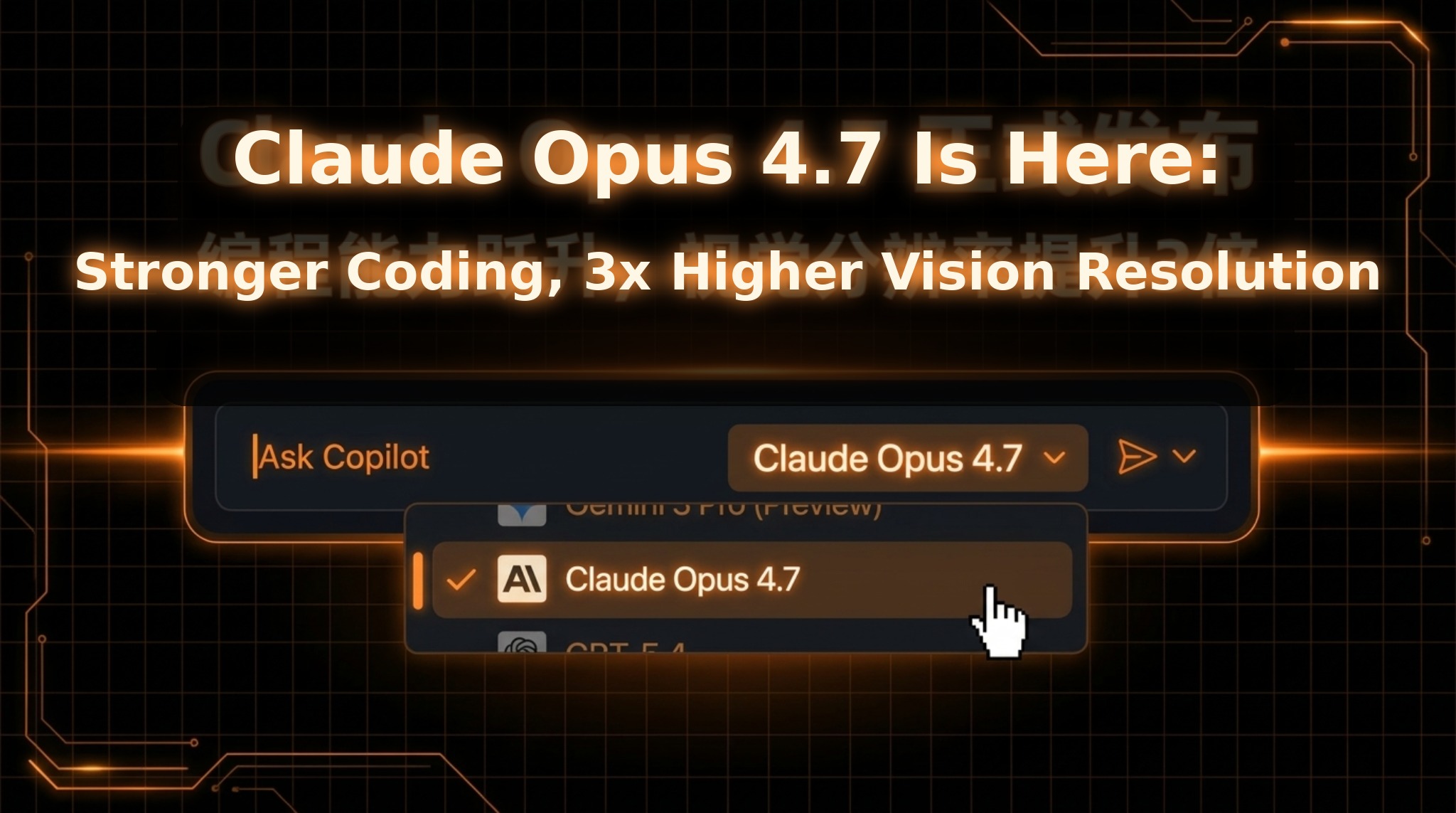
Claude Opus 4.7 Is Here: Stronger Coding, 3x Higher Vision Resolution (2026)
Anthropic officially released Claude Opus 4.7 on April 16, 2026 — same pricing, across-the-board upgrades on core capabilities.
TL;DR
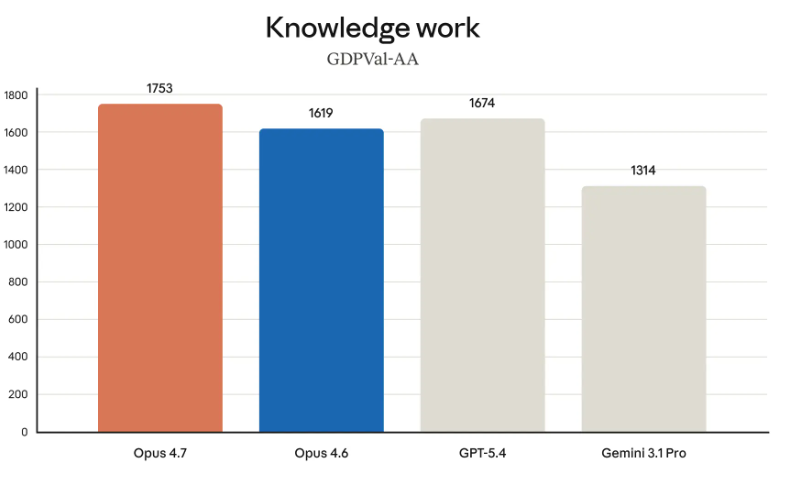
Claude Opus 4.7 is the most capable coding model in the Opus lineup to date. It handles your hardest engineering tasks with minimal hand-holding — and the vision upgrades are equally significant, with high-resolution image processing improved by more than 3x.
What’s New in Opus 4.7
1. Coding: Hand It Your Hardest Problems
Anthropic describes Opus 4.7 as a significant improvement over Opus 4.6 in software engineering — especially on the most complex tasks. Here’s what that looks like in practice:
- Autonomous long-horizon task handling— Completes high-complexity coding work that previously required frequent human intervention, end-to-end on its own
- Output self-verification — The model actively validates its own outputs before returning results, rather than just handing back a first-pass answer
- Stricter instruction following— Instructions are interpreted and executed more literally and precisely
⚠️ Heads up: Because instruction following is now stricter, prompts written for Opus 4.6 may behave differently on 4.7. Edge cases that were previously glossed over will now be enforced. It’s worth re-testing your existing prompts and adjusting as needed.
2. Vision: 3x Higher Image Resolution
This is one of the most concrete, measurable upgrades in Opus 4.7:
| Version | Max Image Dimension | Max Pixel Count |
|---|---|---|
| Opus 4.6 (and earlier) | ~850px | ~0.9 megapixels |
| Opus 4.7 | 2,576px | ~3.75 megapixels |
What this unlocks in practice:
- Computer Use agents:Read dense UI screenshots with far greater detail and accuracy
- Complex chart & diagram parsing:Financial charts, system architecture diagrams, data-heavy tables
- Pixel-level reference design:UI development tasks that require faithfully reproducing visual mockups
No API changes needed. This is a model-level upgrade — just send higher-resolution images and they’ll automatically be processed with greater fidelity. Keep in mind that higher-res images do consume more tokens, so factor that into your cost estimates.
3. Files API Memory: Context That Sticks Across Sessions
Opus 4.7 improves how the model leverages Files API memory, allowing it to retain key information across long, multi-session workflows — significantly reducing the context re-briefing required at the start of each new task.
For developers building with Claude Code or agentic pipelines, this means less time re-explaining background and more time executing.
4. New xhigh Effort Level
Opus 4.7 introduces a new xhigh effort tier, slotting between high and max — giving you finer-grained control over the trade-off between reasoning depth and response latency.
Claude Code has already set xhigh as the default effort level across all plans.
| Effort Level | Best For |
|---|---|
low |
Simple Q&A, fast turnaround |
medium |
Standard tasks |
high |
Complex reasoning |
xhigh(new) |
Hard coding & analysis tasks |
max |
Most complex tasks, highest latency |
💡 Tip: When testing Opus 4.7 for coding and agentic use cases, start with
highorxhigheffort levels.
Pricing & Availability
Pricing: Identical to Opus 4.6
| Official Pricing | ClaudeAPI (20% off) | |
|---|---|---|
| Input | $5 / 1M tokens | $4 / 1M tokens |
| Output | $25 / 1M tokens | $20 / 1M tokens |
For ClaudeAPI users:switching to Opus 4.7 requires zero pricing adjustments on your end.
Where It’s Available
- Anthropic API(
claude-opus-4-7) - Amazon Bedrock
- Google Cloud Vertex AI
- Microsoft Foundry
- GitHub Copilot(promo through April 30 — 7.5x Premium multiplier)
- All Claude product surfaces
Using Opus 4.7 via ClaudeAPI
Getting started with Opus 4.7 through ClaudeAPI:
import anthropic

client = anthropic.Anthropic(
    api_key="YOUR_API_TOKEN",
    base_url="https://gw.claudeapi.com",
)

message = client.messages.create(
    model="claude-opus-4-7",   # updated model name
    max_tokens=1024,
    messages=[
        {"role": "user", "content": "Review this code for edge case handling."}
    ]
)

print(message.content[0].text)
import anthropic

client = anthropic.Anthropic(
    api_key="YOUR_API_TOKEN",
    base_url="https://gw.claudeapi.com",
)

message = client.messages.create(
    model="claude-opus-4-7",   # updated model name
    max_tokens=1024,
    messages=[
        {"role": "user", "content": "Review this code for edge case handling."}
    ]
)

print(message.content[0].text)
Migration Notes
When upgrading from Opus 4.6 to Opus 4.7, there are two changes that affect token usage:
Change 1: New Tokenizer
Opus 4.7 ships with an updated tokenizer. The same input content will now map to roughly 1.0–1.35x the previous token count, depending on content type.
Change 2: More Thinking Tokens at Higher Effort Levels
At xhighand max effort levels, Opus 4.7 generates significantly more reasoning tokens — especially in multi-turn agentic conversations.
How to manage this:
- Use the
effortparameter to control reasoning depth - Explicitly request concise output in your prompts
- Set token caps using the newly launched Task Budgets feature (public beta)
💡 According to Anthropic’s internal benchmarks, when factoring in quality improvements, overall token efficiency still beats Opus 4.6. That said, we recommend benchmarking on your own real-world traffic before adjusting your cost strategy.
Cyber Safety Policy
Opus 4.7 is the first model to ship with Anthropic’s updated cyber safety safeguards. (Claude Mythos Preview had stronger cyber capabilities but was under strict access restrictions.)
Default behavior:
- The model automatically detects and blocks requests involving high-risk or illegal cybersecurity use cases
For legitimate security researchers:
- Vulnerability research, penetration testing, red teaming, and other authorized use cases — apply to join Anthropic’s official Cyber Verification Program
Other Updates Shipped Alongside Opus 4.7
| Feature | Description |
|---|---|
| Task Budgets(Public Beta) | API-level token budget controls — set spending caps for long-running tasks |
| /ultrareview(Claude Code) | Deep code review command that auto-flags bugs and design issues |
| Auto Mode Expansion | Now available for Claude Code Max users — fewer permission interrupts, supports longer-running tasks |
The Bottom Line
OThe core value of Opus 4.7 boils down to this: it turns complex coding tasks that used to require constant babysitting into work you can confidently hand off and walk away from. If you’re running Claude in production for coding or agentic workflows, this is a straightforward upgrade — same pricing, better everything.
The major leap in vision capabilities also opens up new use cases for multimodal applications, particularly tasks that demand high-precision image analysis.
Try It Now
ClaudeAPI already supports claude-opus-4-7,— priced at the same tier as Opus 4.6, at 20% below official Anthropic rates.
Sign Up for ClaudeAPI →
View Full Pricing | API Documentation