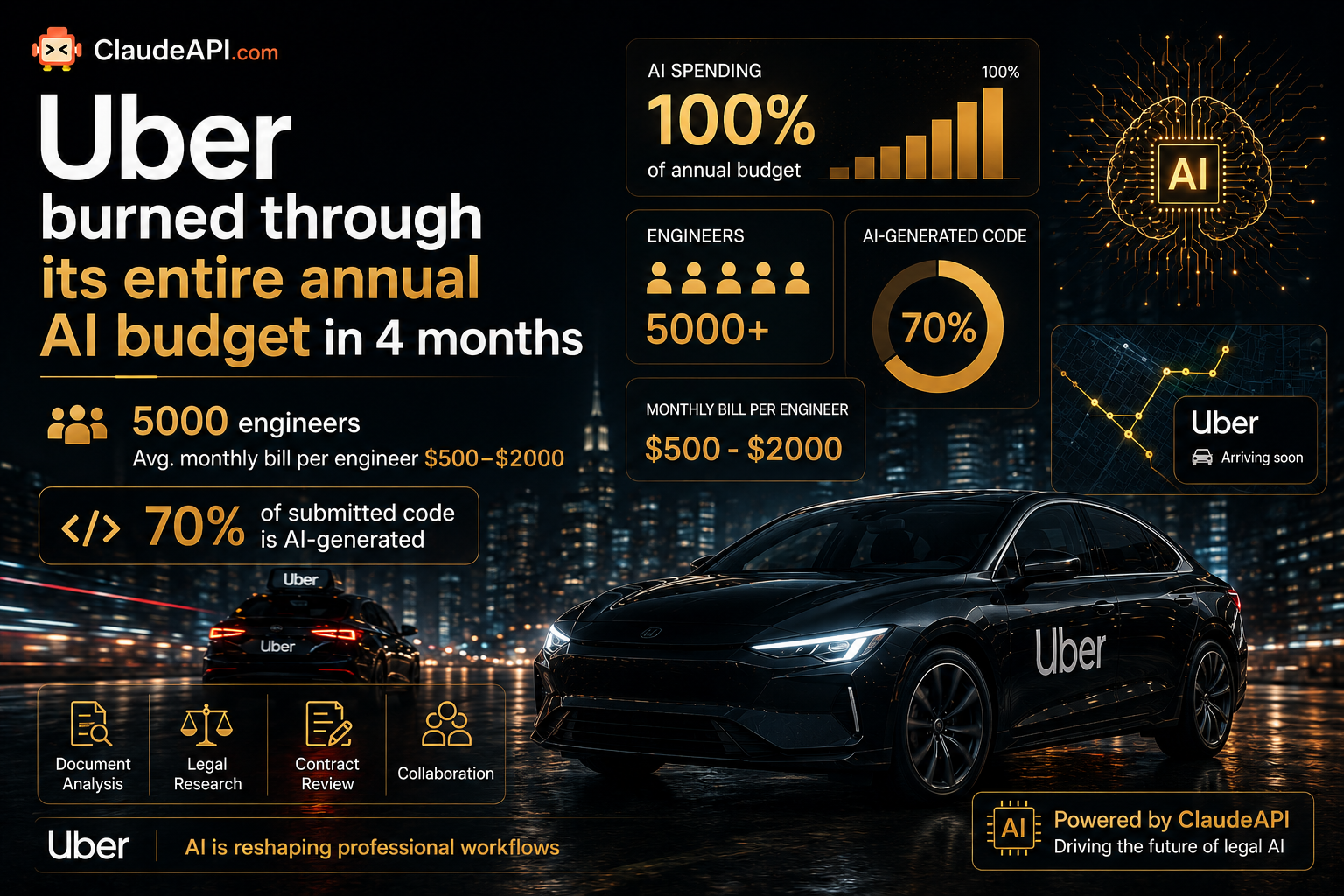
Uber Burned Through Its Full-Year AI Budget in 4 Months: 5,000 Engineers Averaged $500-$2,000 per Month, and 70% of Committed Code Was AI-Generated
Fortune, Briefs, AI Magazine, and several other outlets reported on May 26-27 that Uber had burned through its full-year AI tooling budget by April 2026. The company’s CTO and COO publicly reviewed the issue during an internal all-hands. This is the first public example of an enterprise AI tooling rollout turning into a company-wide billing-control failure.

1. The Full Picture: What Happened
Timeline:
- 2025-12: Uber officially rolled out Claude Code to 5,000 engineers across the company
- 2026-02: Monthly active engineering usage jumped from 32% to 63%, doubling in two months
- 2026-03: 84% of engineers were classified as “agentic coding users,” meaning they were no longer using Claude Code only for completion, but as an agent capable of autonomous multi-step execution
- 2026-04: The AI tooling budget originally meant to last until December was fully spent
- 2026-05-26: COO Andrew Macdonald described the budget incident as a “head-exploding moment” in a media interview, while CTO Praveen Neppalli Naga confirmed there were no plans to add more budget for the year

2. Why It Burned So Fast: Three Underestimated Cost Mechanisms
Many teams saw this news and reacted with: “Uber just did not know how to budget.” The reality is more complicated. The same mechanisms are now appearing in every company that rolls out Claude Code to all engineers.
Mechanism 1: A Structural Mismatch Between Seat-Based Budgeting and Token Billing
Traditional enterprise software is priced by seat: one engineer, one license, with a mostly predictable linear budget. Claude Code does not follow that model. It is billed by token. If an engineer asks for one autocomplete at the end of a function, the cost is almost negligible. If that same engineer uses Claude Code as an agent in a monorepo for an afternoon to “refactor the API layer and add tests,” a single session can run into thousands of dollars.
5,000 engineers × unpredictable agentic behavior = cash flow that completely escapes the rhythm of an annual budget. This was not simply Uber miscalculating. It is enterprise finance models not yet adapting to token-based billing.
Mechanism 2: Internal Leaderboards Turned Token Usage into a KPI
Uber reportedly had an internal leaderboard ranking teams by AI usage. The intent was to increase adoption of AI tools. The result was that engineers had an incentive to push up token usage to appear on the leaderboard. This pattern is known in the industry as tokenmaxxing, and companies such as Meta have reportedly had similar internal dashboards.
Leaderboards equate “using more” with “using better,” but token count does not have a linear relationship with actual output. Macdonald’s point was essentially: if you cannot directly connect this spending to features delivered to users, the deal becomes hard to justify.
Mechanism 3: The “Thinking Cost” of Agentic Mode
In agentic mode, Claude Code plans, breaks work into steps, and calls tools on its own. Every step consumes thinking tokens. Opus 4.7’s adaptive thinking defaults to effort: high, so the model may spend heavily on reasoning when it decides the task requires it. A request that an engineer thinks of as “just write this function” may actually trigger 100,000 tokens of reasoning and tool loops behind the scenes.
That cost is completely invisible to the engineer. They see only the final result, not the intermediate spend.

3. Industry Ripple Effects: Uber Is Not the Only One
| Company | Action | Signal |
|---|---|---|
| Microsoft | The Verge reported in early May that Microsoft canceled most direct Claude Code licenses and asked engineers to use GitHub Copilot CLI instead | Large companies are starting to see Claude Code as an uncontrollable cost |
| Uber | Burned through its budget in 4 months and publicly acknowledged it | The first public example |
| Meta | Internal token-usage dashboards | Tokenmaxxing culture has already formed |
Third-party research points in the same direction. A 2025 Mavvrik survey showed that 85% of enterprise AI costs exceeded expectations by more than 10%, and 84% of companies saw gross margins fall by more than 6 percentage points as a result. Gartner predicts that AI agent software spending will reach around $207 billion in 2026, up 1.4x from $86.4 billion in 2025.
That means Uber’s “head-exploding moment” will repeat across many companies in the second half of 2026, even if most of them never say it publicly.
4. Lessons for Domestic Development Teams: Three Practical Cost-Control Moves
Most domestic teams are less than one-tenth the size of Uber, but the same mechanisms still apply: after a short trial period, one week’s bill suddenly spikes, and a later audit shows that an engineer used Claude Code to refactor an entire repository. These three actions can be taken immediately:
1. Use Prompt Caching to Flatten High-Frequency Context Costs
For large codebases and long-context workflows, prompt caching can reduce the cost of repeated input to 10% of the original price.
import anthropic

client = anthropic.Anthropic(
    api_key="sk-your-ClaudeAPI-key",
    base_url="https://gw.claudeapi.com"
)

response = client.messages.create(
    model="claude-sonnet-4-6",
    max_tokens=2048,
    system=[
        {
            "type": "text",
            "text": "<put key files, conventions, and style guides from the codebase here>",
            "cache_control": {"type": "ephemeral"}
        }
    ],
    messages=[{"role": "user", "content": "Add unit tests for utils/parser.py"}]
)
import anthropic

client = anthropic.Anthropic(
    api_key="sk-your-ClaudeAPI-key",
    base_url="https://gw.claudeapi.com"
)

response = client.messages.create(
    model="claude-sonnet-4-6",
    max_tokens=2048,
    system=[
        {
            "type": "text",
            "text": "<put key files, conventions, and style guides from the codebase here>",
            "cache_control": {"type": "ephemeral"}
        }
    ],
    messages=[{"role": "user", "content": "Add unit tests for utils/parser.py"}]
)
The first call creates the cache. After that, requests within the 5-minute window are billed at only 10% for the cached portion. For workflows that ask Claude to inspect the same codebase multiple times in a day, this alone can save around 70% of token costs.
2. Route by Model Tier: Not Every Task Needs Opus 4.7
Engineers spending $2,000 per month are likely using Opus 4.7 as the default model for everything. But:
| Task type | Recommended model | Price comparison input/output, RMB per million tokens |
|---|---|---|
| Complex architecture, long-horizon reasoning | claude-opus-4-7 | ¥20 / ¥100 |
| 90% of everyday coding and PR review | claude-sonnet-4-6 | ¥4 / ¥20, one-fifth of Opus |
| Classification, extraction, simple completion | claude-haiku-4-5-20251001 | ¥1 / ¥5, one-twentieth of Opus |
Simply changing the “default model” from Opus to Sonnet can cut the bill to one-fifth. Reserve Opus 4.7 for tasks that truly require deep reasoning.
3. Set Monthly Team Budget Caps and Make Usage Visible
The claudeapi.com console provides usage, cost, and request-count details by API key, making it possible to:
- Give each engineer an independent key and track monthly spend separately
- Set spending caps that automatically disable usage after being reached
- Export billing data for team-level and project-level comparison analysis
The core issue in Uber’s budget burn was not “using too much.” It was “only discovering the usage after the money was gone.” Transparent billing plus configurable caps is the most direct way to bring token billing back into a predictable operating rhythm.

5. Final Thought: Tokenmaxxing Is Not a Good Thing
The most important sentence from Uber’s review came from COO Macdonald:
“If you cannot directly connect this spending to how many features were delivered to users, it becomes hard to justify the deal.”
The claim that 70% of committed code is generated by AI sounds impressive, but it does not automatically mean “the product is moving faster.” Token count is not output. A leaderboard is not output either. Using AI well matters more than using AI a lot.
claudeapi.com provides standard API access to the full Claude model family, including Claude Opus 4.7, Sonnet 4.6, and Haiku 4.5. It is compatible with the Anthropic SDK format, with clear billing, transparent usage, API-key-level tracking down to the engineer level, and enterprise billing support. If your team is also evaluating the balance between “AI tool adoption” and “budget control,” start by making every token visible in the console.
Try it now: claudeapi.com · Console: console.claudeapi.com